
Wine doesn’t come with instructions. There is no user’s guide, no owner’s manual, no hint of how to proceed once you get your chosen bottle home. There is the creeping uncertainty of wondering whether you are truly qualified to open your own bottle of wine. After all, aren’t there people who do this professionally? If you order a bottle of wine at a restaurant a waiter or sommelier will bring the bottle to your table, draw the cork, decant a red or chill a white, and keep your glass filled throughout the meal. There are rules, are there not, for the proper serving temperature, for whether to decant, for the right glassware. What if you get it wrong?
Anxiety and resentment pair poorly with a glass of wine. While wine service can feel fussy or pretentious (something you might safely ignore in the privacy of your own home), there is a practical rationale underlying the rules. Understand the reasons behind the ritual and you can focus solely on maximizing your enjoyment.
Wine is a remarkable liquid, the miraculous result of the conversion of sugar into alcohol by yeast. Its principal components include water, alcohol, acid, sugar, phenolic compounds (which give wine its color and structure), and volatile organic compounds (responsible for flavor and aroma). Temperature directly influences a wine’s profile by affecting both the volatility of aroma compounds and how intensely we perceive structural elements like acidity, tannin, and alcohol. The limitations of our senses determine the optimum temperature range for tasting wine, from approximately 45 to 65 degrees Fahrenheit.
When you take a sip of wine, you immediately begin receiving information about its temperature, acidity (that slight, mouthwatering feeling on the sides of your tongue), tannin (the drying, mouth puckering feeling), and alcohol level. (The weight of the wine in the mouth is mostly due to alcohol; lighter bodied wines generally have less and fuller-bodied wines more.) Wines higher in acidity but lower in tannin show best at cooler temperatures while wines lower in acidity but higher in tannin show best at warmer temperatures. Racy, acid-driven wines will taste flabby or flat if served too warm; tannic wines served too cold will taste bitter and astringent. The volatility of ethanol is suppressed at cooler temperatures but rises exponentially at higher temperatures, overwhelming the palate in a rush of heat.
Flavor and aroma are determined by hundreds of organic compounds of different chemical classes, each of which exhibits varying degrees of volatility. Those of high volatility are readily apparent at lower temperatures while those of medium to low volatility require higher temperature to express themselves. The compounds that produce the floral and fruity notes that give white wines their character are highly volatile. Since most of these wines are also high in acidity, they are best served chilled. Those that produce notes such as leather, smoke, or black pepper are most often found in red wines high in tannin, which are best served somewhat warmer. Those flavors and aromas that come from barrel aging fall in the mid-range for volatility. An oaky Chardonnay will show best if served a little warmer than one that is unoaked. Unoaked reds may be better slightly chilled. While cooler temperatures will dull your perception of sugar, sweeter wines are usually served cold in order to emphasize the acidity and balance out the sweetness. An older, vintage dessert wine may be served slightly warmer to accentuate its richness and complexity of flavor. Skin contact whites, or orange wines, with a higher proportion of phenolic compounds, may be served slightly warmer than their unmacerated counterparts.
In practice, most people store their white wines in their refrigerator and their red wines in a rack on the kitchen counter. The default temperature setting on most refrigerators is 38 degrees and the average room temperature 72 degrees. This means that most white wines are served too cold and most reds too warm. The usual solution suggested is the 20/20 rule. Twenty minutes prior to serving, remove your white wines from the fridge or put your reds in. More important than any rule, however, is the knowledge that changes in temperature will alter your experience of the wine. If a white tastes dull or closed, give it a few minutes to warm up in the glass and see if it opens up. If a red wine tastes flabby or hot, don’t hesitate to chill it.
WINE OF THE WEEK
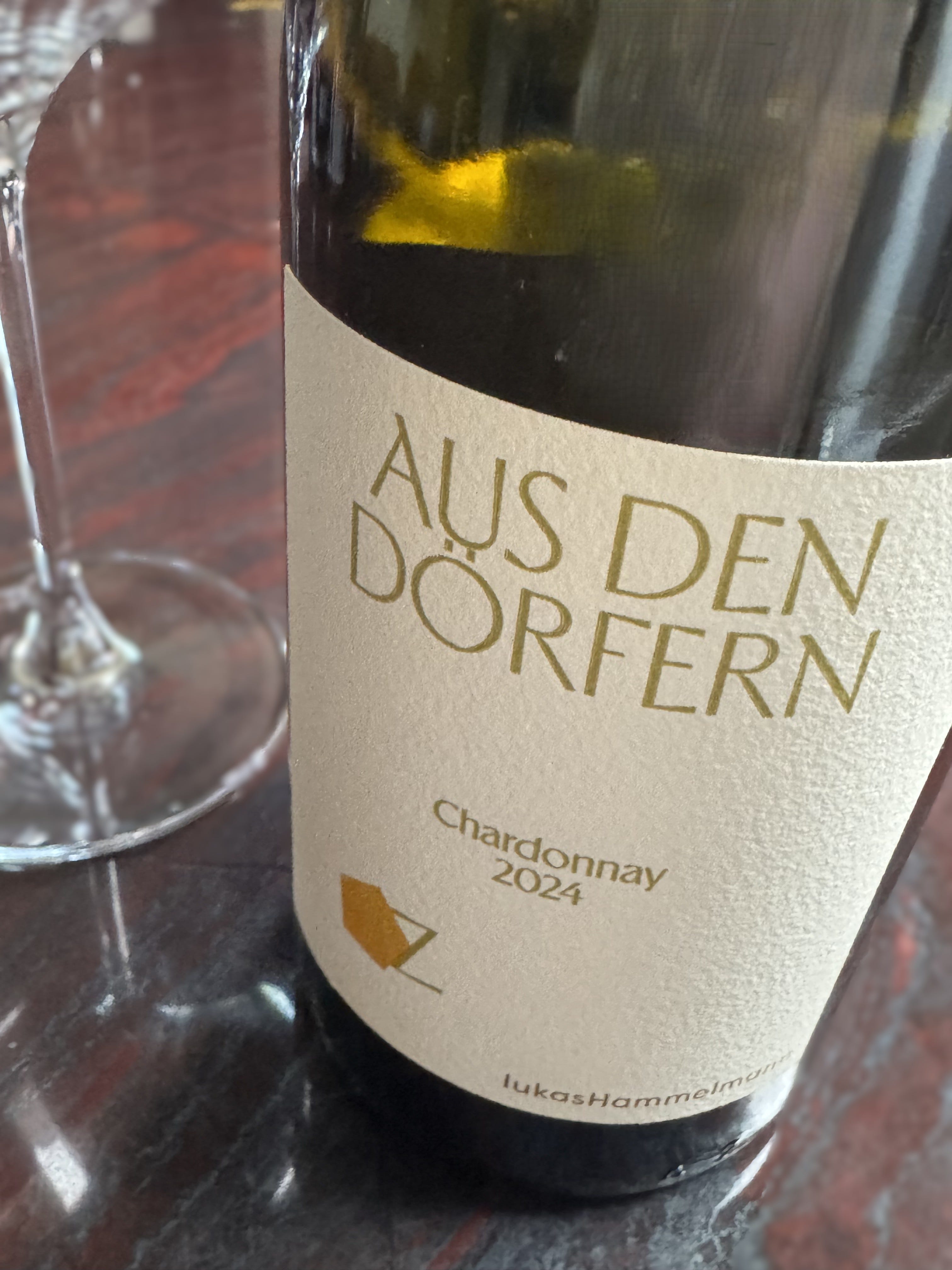
2024 Lukas Hammelmann Zeiskam Aus den Dörfern Chardonnay
Tart. Taut. Tactile. The epitome of restraint. Less is so much more.
Note: Serve at precisely 10 degrees Centigrade. Or not.
The thrill of discovering a rare grape variety for the first time is surpassed only by the exhilaration of encountering a familiar grape variety in an unexpected location. Germany is not known for its Chardonnay, at least not yet. Historically, the climate was too cool for the grapes to ripen properly, but global warming is changing that. The planting of new vineyards has accelerated in the past decade, particularly in the regions of Pfalz, Rheinhessen, and Baden. The emerging style is explicitly though not slavishly Burgundian.
WINE REFERENCE OF THE WEEK
Bonné, Jon. The New Wine Rules: A Genuinely Helpful Guide to Everything You Need to Know. Ten Speed Press, 2017.
I wrote that there is no user’s guide, no owner’s manual when it comes to wine. I lied. This is it. You don’t have to read it cover to cover, but at some point you will likely have read every chapter more than once. It is, as it says on the cover, “genuinely helpful.” Inside is everything useful you would ever want to know about enjoying wine. And don’t skip the Introduction, where Jon encourages us all to “…drink with joy — and never let go of your curiosity.” Very much in the spirit of Wine in Common. I’ll drink to that.
Jon Bonné has been writing about wine and food for over twenty years. He was the Wine Editor and Chief Wine Critic at the San Francisco Chronicle for nearly a decade and has written for many other publications too numerous to list here. In addition to The New Wine Rules, he authored The New California Wine and, most recently, The New French Wine, a remarkably comprehensive work in two volumes.