
Along with country of origin, most retail wine shops and restaurant wine lists use wine type and color as a major organizing principle. You typically see sections devoted to red, white, rosé, and sparkling wines. Breaking the wines down by category helps the consumer navigate an inventory that may run to hundreds or even thousands of bottles.
The human brain faces cognitive overload when confronted with a large number of undifferentiated items from which to choose. Our anxiety abates, and we breathe a mental sigh of relief, when we reduce the demoralizingly complex problem of wine selection to a simple binary choice between “red” and “white”.
Narrowing your options at the outset by deciding “let’s drink red tonight” or “a chilled bottle of white sounds great” allows you to focus your attention on perhaps two or three wines only. Research shows that you will be more satisfied with a choice deliberately made than a wine picked at random due to decision fatigue.
There is risk in relying too heavily on visual cues. Our brain prioritizes optical information over that provided by our other senses. It devotes more resources to it, and processes it much faster. Color can become a proxy for flavor, shaping our expectations of a wine before we have even tasted it. In a now famous 2001 study, a group of enology students at the University of Bordeaux were presented with two glasses of wine, one white and one red. The “red” wine was actually the same white wine dyed with a neutral food coloring. Tasters overwhelmingly described the doctored white wine with notes that we typically associate with red – “tannic”, “spicy”, “berry”. Their eyes told them they were drinking red wine, and so they relied on memory to fill in the appropriate taste descriptors.
Winemakers are all too aware of this tendency. They know, for example, that we associate depth of color with ripe, concentrated, high quality wines. A purple so dark it appears to capture the light signals full-bodied, robust flavor while a pale red is assumed to be “thin” and “weak”. Large industrial producers in California use additives such as “Mega Purple”, a commercial product made from Rubired grapes, to heighten the color of their low to moderately priced red wines. Our brains are fooled into thinking that we are drinking something much more expensive.
One final cautionary note. It is all too easy for “let’s drink red tonight” to default to “I only drink red” or worse still “I’m a red wine drinker”. The choice of a moment hardens into a fixed, unwavering preference and ultimately your entire identity.
“Red” and “white” can be a useful shorthand but a great deal of detail and nuance is lost. “Red” also includes rosé wines. “White” includes macerated, or orange wines. Both include wines made in a dry or sweet style, still or sparkling. And within each type are light bodied and full bodied wines and everything in between. There is such an incredible diversity of wines to explore that I urge to taste broadly and fearlessly. And don’t forget to take a moment to admire the color.
A young white, bright yellow, the color of a daisy’s eye…she loves me, she loves me not. A mature red, tawny orange, the fading memory of a glorious summer remembered now only by a few. A rosé, dusky pink, a brooding twilight hue, a lullaby singing the westering sun to sleep.
Wine in our glass, we rush it to our lips, eager to taste. Pause for a moment, please, and lift it to the light. Color can reveal much about a wine, but for the moment, let it keep its secrets. Let us admire it only, thrilling in the interplay of light and shadow, a kaleidoscope of color.
WINE OF THE WEEK
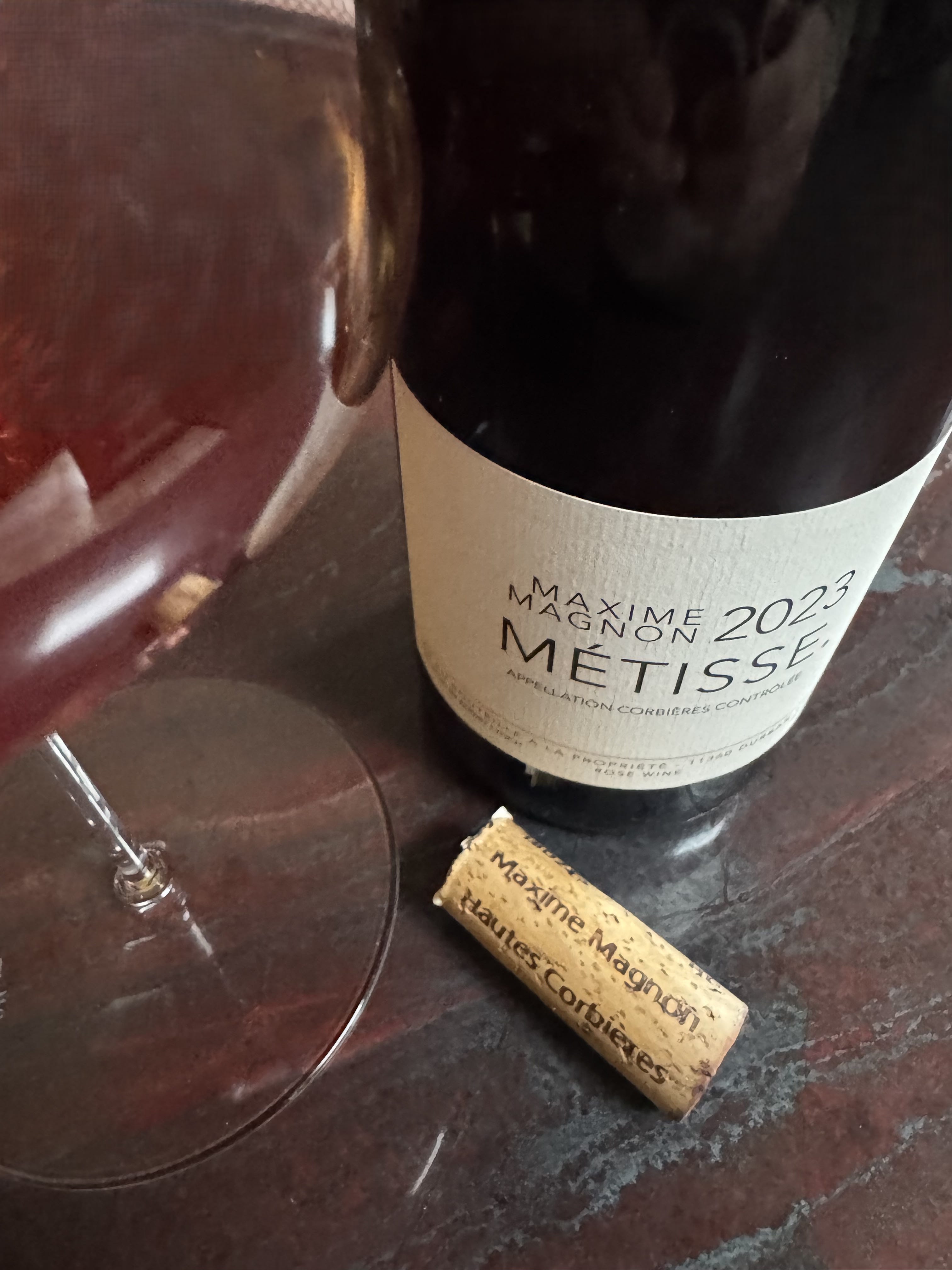
2023 Maxime Magnon Métisse Corbières Rosé
What is rosé and what is red? Where is the line drawn? Does it matter?
From the foothills of the Pyrenees Mountains north of the border with Spain. A blend of 60% Grenache, 20% Cinsault, 20% Carignan. 80 year old vines. Direct pressed.
A quiet, bookish wine with nothing to prove. Reserved. Cerebral. Enjoy it in companionable silence.
WINE REFERENCE OF THE WEEK
de La Rivière, Florence, and Bénédicte Bortoli. The Look of Wine: Reading Wine Color. Photographs by Jérôme Bryon, Abrams, 2025.
Published in French as L’Oeil du vin: Lire les couleurs du vin. A remarkable marriage of science and art, this is a serious reference work masquerading as a coffee table book. Visually stunning. Illuminating.