
No nation is drunken where wine is cheap; and none sober, where the dearness of wine substitutes ardent spirits as the common beverage.
On December 13, 1818, Thomas Jefferson penned a letter to the French ambassador to the United States. He made clear his opposition to the high tariffs imposed on imported French wine. High prices made wine a luxury affordable only by the very wealthy, while the common man turned to hard liquor to satisfy his thirst. In early 19th century America, whiskey and rum were consumed at every hour of the day and in such quantity that visiting Europeans were shocked by the degree of drunkenness among the citizenry of the new republic. Jefferson’s commitment to lower tariffs reflected both his ideal of an agrarian society and his personal desire to lower his own wine bill. He spent so much money on imported French wines that he died deeply in debt. The contents of his wine cellar, along with his entire estate, were sold off at the time of his death to help repay his creditors.
Two centuries later, the most sought after French wines are still a luxury only the rich can afford. A single bottle of Grand Cru Burgundy or First Growth Bordeaux can sell for thousands or even tens of thousands of dollars. Unlike our colonial forbears, however, we have access to much cheaper wines. A 750 ml bottle of Yellowtail Chardonnay can be yours for the price of a Starbucks latte.
Faced with a bewildering selection of wines that make comparison difficult and success uncertain, we all resort to shortcuts when purchasing a bottle. We might be seduced by a pretty label or recognize with relief a familiar appellation or producer. Mostly though, we rely on price to guide our choice. Should we though? Can we trust ourselves to make sound judgments based on price alone? To what extent does price reflect quality? Does quality always increase along with price?
For the consumer, buying wine on price alone is an absolute minefield. Retailers are aware that the $10 and $20 price points command consumer attention and will adjust their costs in order to hit that $9.99 or $19.99 target. They may advertise a much more expensive wine alongside a cheaper one, which we then perceive as a better value by comparison. Behavioral scientists call this “anchoring bias”. Three price points may be presented with the intention of upselling the low-price buyer to the next tier. This is what’s known as the “Goldilocks effect”. It is in our nature to want to avoid spending too much or too little so most will choose the medium-priced wine. The current prevailing market trend is what the industry calls “premiumization”, meaning consumers are spending less money overall on wine, but increasing the amount spent per bottle. In response, producers are focusing more heavily on the $15 to $25 price point. Some of these wines offer good value but many are wines of lower quality “dressed up” with fancier packaging.
The formula for making a profit selling wines at less than $10 per bottle is low cost, low margin, and massive volume. Low-priced wine is produced on an industrial scale. Barefoot Wines, owned by E&J Gallo and one of the top wine brands in the world, sells over 250 million bottles each year. Vineyards are mechanically harvested with yields of ten or more tons per acre. Oak flavor is achieved by adding wood chips or staves. Lightweight bottles and screwcaps or synthetic corks are chosen over more expensive options.
Producers who offer wines at higher price points can afford to spend more on production. Grapes are hand harvested, sometimes from a single vineyard. Yields are much more strictly limited, often as little as two tons per acre. Barrel aging is typical, with new French oak barrels costing $1000 or more. Packaging is often tied closely to brand quality, with heavier glass bottles, natural corks (often sealed with wax), and finer labels.
The key thing for the consumer to understand is that the fixed costs of bringing a bottle of wine to market such as packaging, logistics, applicable taxes, etc. are more or less the same regardless of the per bottle price. This means that the first real jump in quality, where the price begins to reflect more of the value of the wine itself, is between $15 and $20. As a general rule, this optimum price to quality ratio continues up to the $50 price point. Beyond that, you pay a price premium that reflects a number of other factors over and above quality per se such as limited production, a prestigious producer, appellation, or single vineyard, or a 100 point score from a revered wine critic.
I have been drinking wine for more than forty years. In that time I have had the good fortune to taste a number of rare and expensive wines. Yet I typically spend no more than $15 to $25 for a bottle I will drink during the week, and $30 to $40 for a bottle to enjoy on the weekend. That $15 to $30 “sweet spot” is where I tend to find the most value. The pleasure one gets from tasting a once in a lifetime wine is easily matched by the undiluted joy of discovering a wine you would happily buy more of for less than $30.
WINE OF THE WEEK
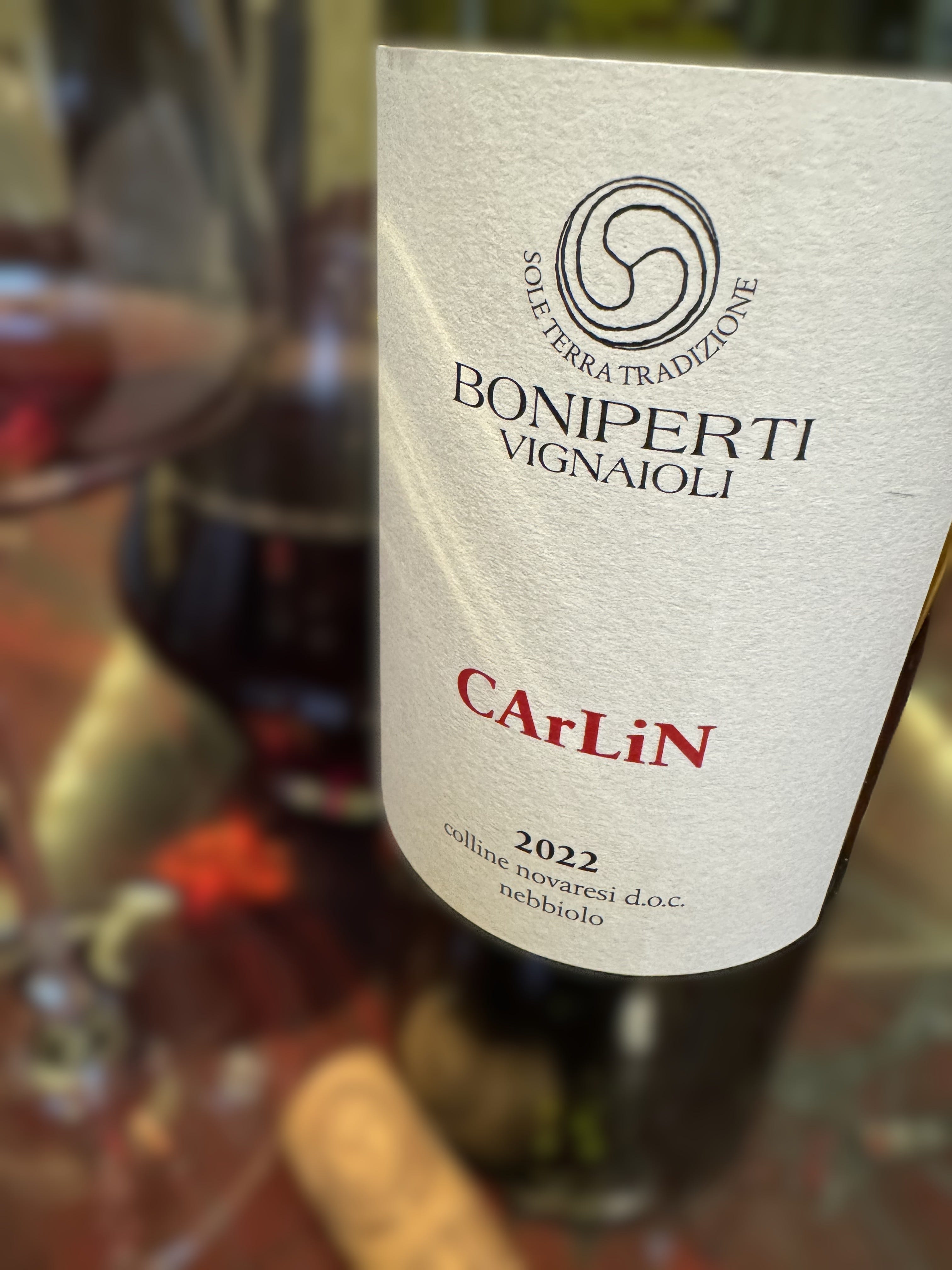
2022 Vignaioli Boniperti, Carlin Colline Novaresi Nebbiolo
100% Nebbiolo (known locally as Spanna) from northern Piedmont in the shadow of the Italian Alps. From family vineyards abandoned after World War II and reclaimed/replanted in 2003. This region of Alto Piemonte is producing some of the best values in Italian Nebbiolo today. Forget the prestigious crus of Barolo and Barbaresco to the south, this is where you go if you want a bottle to drink tonight that won’t break the bank.
Perfumed. Polished. Beguiling. Classic. Pour yourself a glass and you’re suddenly transported to a little osteria in Novara, eating risotto and sipping the local wine. Less expensive than airfare to Italy, and you can lean your seat all the way back if you want to.
WINE REFERENCE OF THE WEEK
Sohm, Aldo, and Christine Muhlke. Wine Simple: A Totally Approachable Guide from a World-Class Sommelier. Clarkson Potter, 2019.
This is a totally approachable guide from a world class sommelier. I know because it says so right on the cover. Aldo Sohm, is a, well, somm. He is originally from Austria but since the early 2000’s has been firmly established in the NYC food and wine scene. Wine Simple is a beginner’s guide in the traditional mode but is anything but traditional. The text and graphic design are an unexpected delight and beautifully reflect the wry humor that imbues every page. It is seriously unserious, full of useful information that most readers won’t fully appreciate immediately. And it is painfully and admirably earnest in wanting to help you enjoy wine more.
The section in Chapter 1 on “Key Winemaking Regions” also includes frequent asides on where to find the best values in wine. And be sure to read “Aldo’s Wine Rules” on page 19. The last two, “Wine’s number one job is to bring us together” and “In the end, there are no rules when it comes to wine”, qualify Aldo as an honorary member in good standing of Wine in Common.